Connecticut’s Small-Town Grange Fairs: The State’s Best-Kept Fair Secret

July 19, 2026 · 4 min read

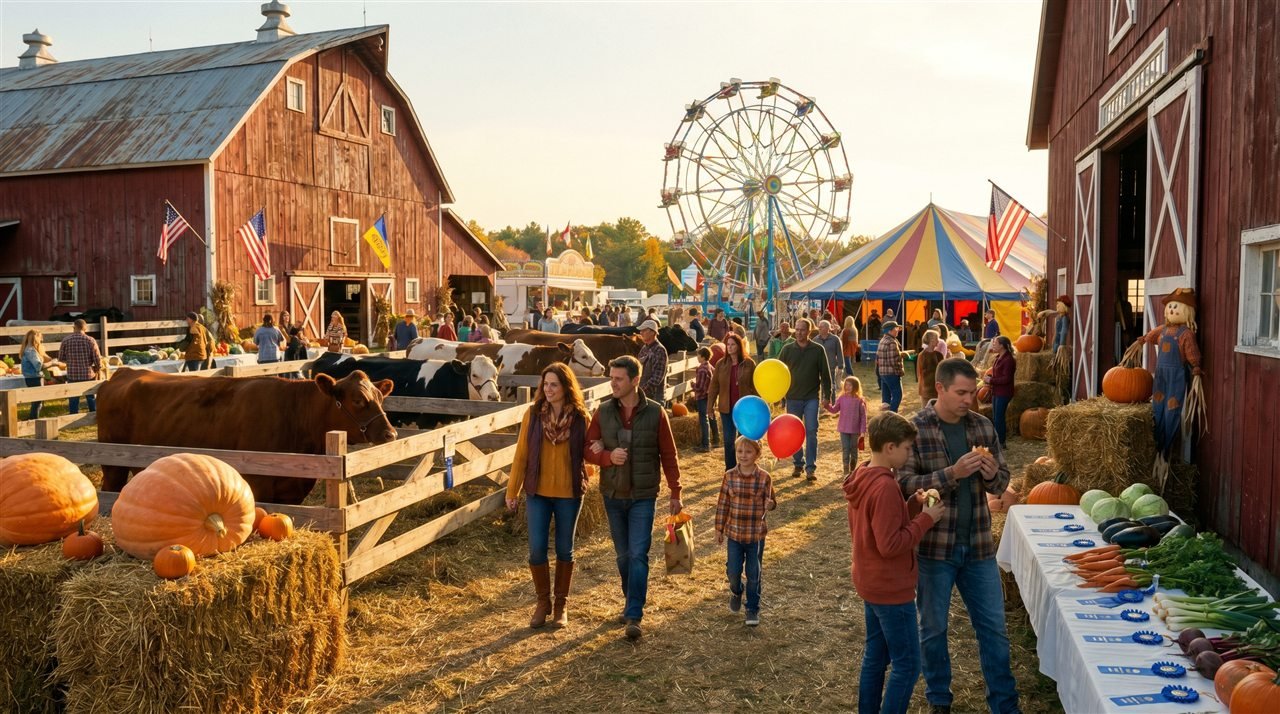
Long before Connecticut’s county-scale agricultural fairs drew crowds thick enough to back up traffic on a two-lane road, farm families organized under a different banner: the Grange, a nineteenth-century fraternal order built to give rural communities a shared hall, a shared voice, and eventually a shared fair. Walk into one of these events today and the fried dough and blue ribbons are still there, but so is something quieter, homemade pies cooling on folding tables, a raffle table stacked with jars of local honey, 4-H rabbits judged one at a time inside a wood-frame hall that has hosted the same fair for generations.

Connecticut still holds eleven Grange fairs, and most of them rarely make the same roundups as the Durham Fair or the Goshen Fair. This guide covers seven of them, from the Litchfield Hills to the Quiet Corner, tracing the institution that built them and pointing toward a fair season built around a folding chair and a church-basement bake sale rather than a midway.

The Grange: New England’s Farmers’ Fraternal Order

The Grange, formally the National Grange of the Order of Patrons of Husbandry, was founded in the 1860s as a fraternal order for farm families, organized around local chapters that gave rural communities a hall for meetings, socials, and mutual aid at a time when agricultural work was often isolating. New England farm towns chartered local granges by the dozens in the decades that followed, and in many of them the fair became the chapter’s one big public event of the year, run by the same members who kept the hall’s lights on the rest of the season.

That structure still shows in how these fairs operate. Where a county agricultural fair like the Woodstock Fair answers to an agricultural society board, a Grange fair typically answers to the Grange hall itself, with members supplying the exhibits, staffing the judging tables, and running the food tent. Connecticut counts eleven of these fairs today, including the Cheshire Grange Community Fair, the Cannon Grange Agricultural Fair in Wilton, the Greenfield Hill Grange Fair in Fairfield, and the Simsbury Grange Agricultural Fair, alongside the seven covered here.

West of the River: Litchfield Hills and Fairfield County

The Riverton Grange Fair sets up in the Litchfield Hills village of Riverton in August, ahead of the region’s cluster of October agricultural fairs, with the agricultural, craft, and family judging categories typical of a Grange-run event. A short drive away, the Winchester Grange Fair takes over Winchester Center the same month, formally billed as a fair and flea market, a pairing that reflects how much these events still depend on members improvising a program around the hall rather than following a fixed agricultural-society template.

Down in Fairfield County, the Norfield Grange Agricultural Fair & Market runs in Weston each September and stretches its category list furthest of the seven, into food-festival territory alongside the standard agricultural and craft judging. It is the closest of this group to a modern market-day event layered onto an old fraternal fair, and a useful stop for anyone assuming every Grange fair looks identical.

Hartford County, the Shoreline, and the Quiet Corner

East of the river, the Granby Grange Agricultural Fair and the Hillstown Grange Agricultural Fair both fall within Hartford County, the Hillstown fair set in East Hartford and Granby’s version in its own town, and both hold to the agricultural-craft-family formula that defines the format statewide, both landing in September.

On the shoreline, the Wallingford Grange Fair gives New Haven County its own September Grange date, distinct from the county’s other agricultural fairs like the North Haven Fair or the Guilford Fair. Furthest east, the Ekonk Community Grange Fair holds down the Quiet Corner from Sterling in August, sharing the region’s calendar with the Brooklyn Fair and Woodstock Fair, a reminder that the Grange model reached every corner of the state, from the shoreline to the Quiet Corner to the Litchfield Hills.

Planning a Grange Fair Weekend

Grange fairs run on volunteer labor and a fraction of the budget of the state’s largest agricultural fairs, so admission tends to be modest, though exact gate prices vary fair to fair and year to year and are worth confirming directly with the local Grange rather than assuming a flat statewide rate. Most of what’s inside, the exhibit halls, the judging, the craft tables, runs on that single gate fee, since these events rarely carry a midway or a ticket-strip economy to begin with.

Arrive early if you want to watch judging happen rather than see only the ribbons already pinned, and check each Grange’s own listing close to the date, since a volunteer-run fair is more likely than a large county fair to shift its hours around weather or staffing. Pair one of these seven with a nearby town green or a bigger fair already on your calendar the same month, and treat the Grange hall itself as part of the exhibit, a piece of nineteenth-century Connecticut still doing the job it was built to do.

Related fairs