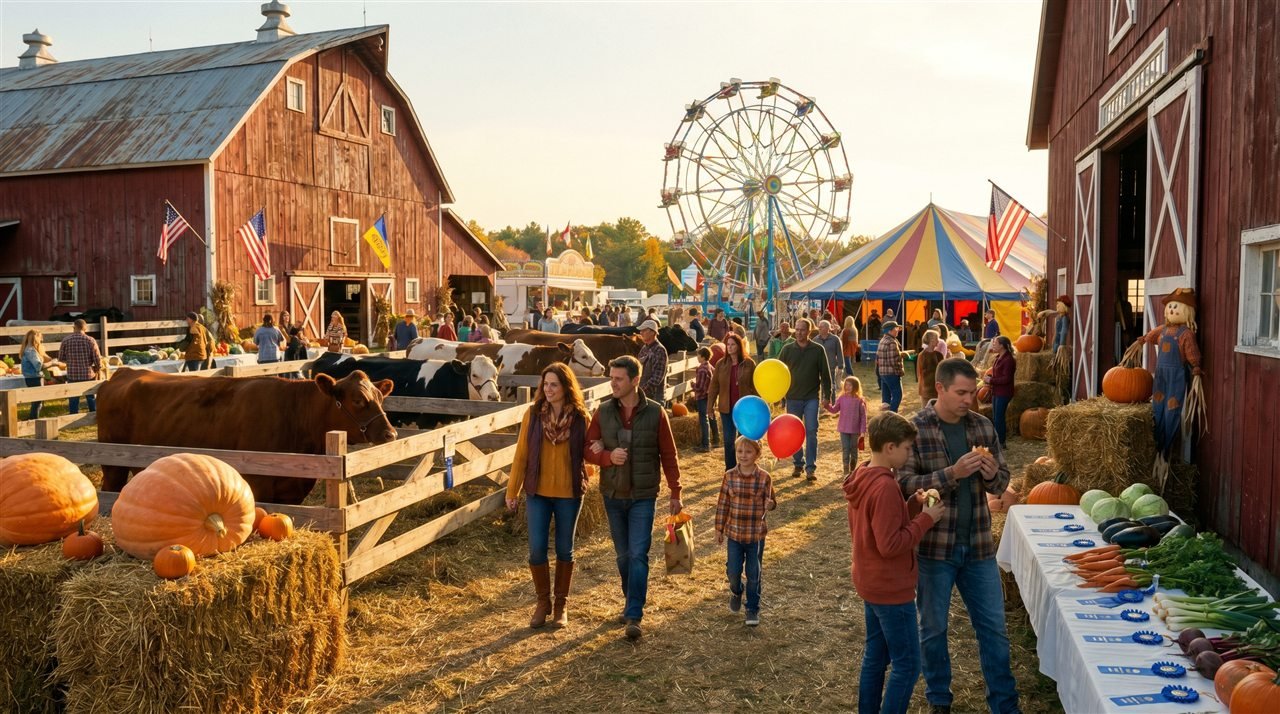
The Brooklyn Fair has the earliest listed founding year of these twelve fairs, 1809, and the Durham Fair the latest, 1916. Six list a year before the Civil War, and nine list one before 1900. In order: Brooklyn 1809, Four Town 1838, Harwinton 1853, Guilford 1859, Goshen and Woodstock 1860, Chester 1877, Wapping 1892, Hamburg 1897, Haddam Neck 1911 and Durham 1916. Riverton lists none.
A listed founding year does not show unbroken annual operation.
1809: Brooklyn
The Brooklyn Fair is in the Quiet Corner town of Brooklyn, in Windham County.
1838 to 1860: Four Town, Harwinton, Guilford, Goshen and Woodstock
The Four Town Fair in Somers dates to 1838 and serves the four surrounding towns. The Harwinton Fair followed in 1853, and the Guilford Fair, run by the Guilford Agricultural Society, in 1859. Two fairs date to 1860: the Goshen Fair and the Woodstock Fair, which both ran over Labor Day weekend.
1877 to 1916: Chester, Wapping, Hamburg, Haddam Neck and Durham
The Chester Fair, founded in 1877, was held in the lower Connecticut River Valley and had a pie-baking contest. The Wapping Fair in South Windsor dates to 1892, and the Hamburg Fair, run by the Lyme Grange, dates to 1897. The Haddam Neck Fair, which ran over Labor Day weekend, dates to 1911. The Durham Fair, founded in 1916, has the latest listed founding year.
Riverton: no listed founding year
With no founding year listed, the Riverton Fair, an October country fair in a Litchfield Hills village, falls outside the order above.
Who runs them now
Agricultural societies organized county and town fairs in the 1800s to share farming knowledge and to judge livestock and produce against a standard, decades before extension services or 4-H existed. Agricultural societies still run the Brooklyn, Goshen, Woodstock, Guilford and Harwinton fairs, the Lyme Grange runs the Hamburg Fair, and the Chester Hose Company runs the Chester Fair.
Three of the fairs on this list overlapped on Labor Day weekend: Woodstock on September 3 to 7, Haddam Neck on September 4 to 7 and Goshen on September 5 to 7.